History of Ilizarov Surgery in Malaysia

Ilizarov surgery was introduced in Malaysia in the early 90s and was done sparingly in a few hospitals.
In 1995, Ilizarov surgery was started as a discipline in UH under Prof. Saw Aik and in Hospital Seremban by Dr. Thirumal. Gradually from mere bone loss it was being done for deformity correction, joint contracture and fracture fixation. Currently, it is being done for a whole range of indications. To popularise the field further, basic Ilizarov course was run yearly from 1998 to 2005 in UH and the deformity course was run yearly in UH from 2006. The national Ilizarov course was run yearly from 2006 to 2012 in Hospital Klang. Ilizarov courses were also held in various towns in Malaysia: Kuching, Johor Bahru, Mekala, Bintulu, Sg Petani, Kuala Terengganu, Seremban and Kuantan. The main coordinators for these courses have been Prof Saw Aik, Dr Thirumal and Dr Basir. Prof Saw Aik played an important role and shouldered the role of a leader until 2010 representing Malaysia in the international ASAMI meetings. He then passed on this responsibility to Dr Thirumal.
The first official ASAMI Malaysia Congress was held in 2013 and the second in 2015 in Klang, Malaysia. Since then the ASAMI meeting has been alternating with the National Ilizarov Course. The last Ilizarov course was held in Miri, April 2016. To further popularise this field and to increase the number of surgeons in this field, fellowship trainings was started in UH and in 2006 it was started in the Ministry of Health. Since then, 7 surgeons have graduated with sub-speciality in Ilizarov from the Ministry of Health.
We officially became members of the international ASAMI in 2013. To-date we have 20 surgeons.
Development of Ilizarov Surgery in Malaysia
Principles of distraction osteogenesis was developed by Ilizarov from Kurgan, Russia, in the middle of last century. However, this treatment method was not known to the rest of the world until June 1981 when Ilizarov was invited to present his work in 22nd Italian AO Meeting in Bellagio, Italy. From Europe, Ilizrov surgery was later adopted by surgeons from North America. In 1988, KS Sivananthan performed Ilizarov procedures on three patients following his visit to United States , and subsequently presented his experince during a conference on the following year. In 1991, the first Ilizarov workshop was organised in Kuala Lumpur. Following this, Dr Sengupta started to perform deformity corrections for children in University Hospital Kuala Lumpur. In 1995, Ilizarov surgery for trauma was started by Dr Thirumal in Hospital Seremban and Dr Saw Aik in University Hospital Kuala Lumpur. Ilizarov procedure has expanded the indications of external fixation from providing temporary immobilization for open fractures to providing definitive fixation for complicated fractures and correction of complex limb deformities.
With increasing popularity of Ilizarov procedure, the first basic Ilizarov course was organised in University Malaya in 1991. Dr. Juanito Xavier from Manila was the invited faculty for this course. Subsequently, advanced Ilizarov course were also organised and Dr Maurizio Catagni was one of the few regular invited faculty for these courses. An informal ASAMI Malaysia group were formed by the local orthopaedic surgeons who are doing Ilizarov surgery to facilitate discussions on difficult cases and provide faculty support for the local courses . In 2004, Limb Lengthening and Recostruction Surgery (LLRS) interest group were formed by Malaysian Orthopaedic Association. Following the introduction of Taylor Spatial frame in 2007 , more courses with hands-on workshops for ring fixator, uniateral fixator and hexapod system have been organised in this country, although the standard Ilizarov ring fixator remained as the most versatile and effordable system. Many courses has been organised in different cities around the country including Kuching, Johor Bahru, Mekala, Bintulu, Sg Petani, Kuala Terengganu, Seremban and Kuantan. In 2009, University Malaya has orgnised the first Limb Deformity Correction Course that provide more comprehensive training for treatment for complex limb deformity. Ministry of Health of Malaysia has also organised advaced trauma fellowships for Orthopaedic surgeons interested in Trauma as a subspecialty.
Malaysia has been activey involved in regional and international ASAMI meetings. Dr Saw Aik has represented the ASAMI Malaysia until 2010 when Dr Thirumal took over the Chairmanship. In 2016 Dr Chua Yeok Pin became the third chairman. The first ASAMI Malaysia Congress was held in 2013 and the second in 2015 in Klang, Malaysia. Since then the ASAMI meetings have been alternating with the National Ilizarov Course. The last Ilizarov course was held in Miri, April 2016. To further popularise this field and to increase the number of surgeons in this field, fellowship trainings was started in University Malaya Medical Centre (previously known as Universiy Hospital Kuala Lumpur) and subsequently in the Ministry of Health. Since then, 7 surgeons have graduated with sub-speciality in Ilizarov from the Ministry of Health. Over the last three years, Orthopaedic surgeons from other countries have come to Malaysia for long and short fellowship attachments to advance their clinical skills in Ilizarov surgery.
ASAMI Malaysia officially registered under ASAMI International in 2013 with about 20 orthopaedic surgeons actively involved in the activities. The organization was registered as a society in 2016 and hopefully it will be able to encougare more young surgeons from Malaysia and this region to specialized in this field to provide better treatment for those with severe trauma, difficult complications, and complex limb deformities.
About Our Logo
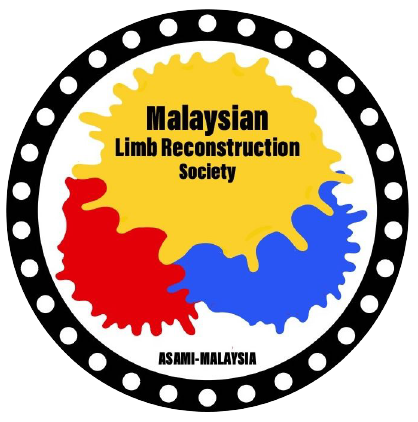
The logo of the Malaysian Limb Reconstruction Society (MLRS) (Persatuan Rekonstruksi Anggota Malaysia) reflects the society’s commitment to excellence in limb reconstruction surgery, the eradication of infection, innovation in orthopaedic care, and professional unity among its members.
Central Circular Design
The prominent black outer circle and white inner circle symbolize the Ilizarov ring, one of the most important implants used in limb reconstruction surgery.
- Black represents the strength, stability, and reliability of the fixation systems used in complex limb reconstruction procedures.
- White represents purity, cleanliness, sterility, and the ultimate goal of eliminating infection during limb reconstruction treatment.
Malaysian National Colours
The logo incorporates the colours of the Malaysian flag—white, red, blue, and yellow—representing both national identity and the core values of the society.
- White – Purity, cleanliness, sterility, and freedom from infection.
- Red – Strength, courage, and stable fixation techniques essential for successful reconstruction.
- Blue – Unity, collaboration, and professional fellowship among orthopaedic surgeons dedicated to limb reconstruction.
- Yellow – Royal authority and excellence, reflecting the power and effectiveness of the Ilizarov principles in overcoming complex limb reconstruction challenges.
Three Irregular Circular Elements
The three overlapping irregular circular shapes resemble water splashes, symbolizing infectious organisms and pathological conditions that can be successfully eradicated through modern limb reconstruction techniques based on the principles of the Ilizarov method.
Their overlapping arrangement represents:
- Unity and teamwork among members of the society.
- Continuous discussion, knowledge sharing, and collaboration.
- Collective efforts to achieve the best possible outcomes for patients requiring complex limb reconstruction surgery.
Heritage and Global Connection
The inclusion of ASAMI–Malaysia acknowledges the society’s historical roots. ASAMI stands for Association for the Study and Application of the Methods of Ilizarov, a globally recognized name used by limb reconstruction societies worldwide that practice and promote the principles established by Gavriil Ilizarov.
The logo therefore represents the society’s proud heritage, international affiliation, dedication to advancing limb reconstruction surgery, and commitment to improving patient outcomes throughout Malaysia.